
All You Need for Trading Stocks is Stock Prices!
Short Term Trading Signals
GAP ‡ RESTART ‡ MONDAY-MORNING ‡ TURN-BACK ‡ OPTIONS-EXPIRATION ‡ FLAG-PENNANT ‡ TREND-LINES
All You Need for Trading Stocks is Stock Prices!
Short Term Trading Signals
GAP ‡ RESTART ‡ MONDAY-MORNING ‡ TURN-BACK ‡ OPTIONS-EXPIRATION ‡ FLAG-PENNANT ‡ TREND-LINES
If you
like content on this page, please do share with your friends on Facebook:
Here is one important signal that gives you almost one trading signal every week! This is a simple signal and all it takes to identify it is just two prices --Friday's Close (FC) and Monday's Open (MO) prices! Also because this signal is very simple, it tends to fail more often than the signals discussed earlier. However, the Stop-loss is very narrow for this signal and hence a losing position gets closed generally within a few hours with minimal damage to our portfolio. Thus the success rate may be lower for this signal, but this signal does have impressive payoffs. This signal gives many opportunities to earn profit two to three times more than the risk undertaken.
What is the logic behind this signal?
There are certain justifications for this signal that make it a powerful indicator for the subsequent few days' price trend.
This all gets reflected in Monday's market opening as well in trading throughout the day. So I think Monday's open price is a powerful indicator for the stock prices for the subsequent few days. Let us know explore how to apply this signal and trade stocks based on it.
As said earlier, this signal is not suitable for every one. It makes sense for traders who typically hold a position only for a few days from one to three/five days at most! This signal is suitable for people who are in constant touch with the market and who can open/close positions without any hesitation within a few hours.
With this signal you get an indication to buy or sell a stock exactly on Monday morning. As soon as the market opens on Monday morning, you can execute a trade within the next few hours. Let us now see how to enter into a position using this signal.
FOR A RISING STOCK (IN A BULL/UP TREND)
CASE 1: If the trend is up and Monday Morning Open price (MO) is HIGHER than Friday's Close (FC), you can take a long position as soon the stock/index trades HIGHER than the opening price. Keep a Stop-loss at Monday's Open price minus ½ % (preferred Stop-loss) or Friday's Close price minus ½ % (for people who hate to open and close positions too hastily).
CONDITIONS:
1. Trend is Up (One quick way is to look at the price chart and see the
current price trend).
2. MO > FC, the stock price seems to be going up from today's
opening level.
ACTION: You BUY this stock preferably after it starts trading higher than today's opening price level. As trading during the first 10-15 minutes of a day is usually unstable, it is also advisable to wait a few minutes (10 to 30) before you take any action. This gives the stock/market sometime so the trading becomes normal and we can feel the trend for the day more confidently.
CASE 2: If the trend is Up and Monday morning Open price (MO) is LOWER than Friday's Close (FC), you can take a short position as soon as the stock/index trades LOWER than the opening price/level. Keep a Stop-loss at today's Open plus ½ % (preferred Stop-loss) or Friday's Close price plus ½ % (for people who hate to open and close positions too fast).
CONDITIONS:
1. Trend is Up (One quick way is to look at the price chart and feel the
current trend).
2. MO < FC, and it starts going down from the opening level.
ACTION: You can BOOK PROFIT in a long position (or Short Sell it if you a courageous trader) in this stock preferably after it trades somewhat lower. It is also advisable to act after 10 to 30 minutes after the market open so the stock has time to cool down from the morning's choppy trading. Though we might lose some gains, this makes us more confident about our assessment of the trend emerging.
FOR A FALLING STOCK (In a Bear/Down-trend)
CASE 3: Now if the trend is Down and Monday morning Open price (MO) is LOWER than Friday's Close (FC), you can take a short position as soon the stock/index trades LOWER than the opening price. Keep a Stop-loss at today's Open plus ½ % (preferred Stop-loss) or Friday's Close price plus ½ % (for people who hate to open and close positions too quickly).
CONDITIONS:
1. Trend is Down (One quick way is to look at the price
chart and feel the current trend).
2. MO < FC, and it seems to be going down from the opening level.
ACTION: Not only you should close your existing Long positions but you can also SELL/SHORT this stock when it starts trading lower than the day's opening price. It is also advisable to wait a few minutes (10 to 30) so the trading in the stock becomes normal and we feel more confident about the trend emerging for the day.
CASE 4: If the trend is down and Monday morning Open price (MO) is HIGHER than Friday's Close (FC), you can close current Short positions and/or take long positions as soon as the stock/index trades HIGHER than the opening price/level. Keep a Stop-loss at today's Open minus ½ % (preferred Stop-loss) or at Friday's Close price minus ½ % (for people who hate to open and close positions too rapidly).
CONDITIONS:
1. Trend is Down. (One quick way is to look at the price chart and
feel it).
2. MO > FC, and it starts going up from the opening level.
ACTION: You can COVER (or BUY for more active traders) this stock not at the opening price but after it trades somewhat higher. It is also advisable to wait a few minutes (10 to 30) before trading to give the stock time to cool down from the morning's choppy trading.
Now let us see how we can apply this signal in real life. Following is a Chart from the famous NASDAQ market index ^IXIC. On the chart, vertical dotted lines represent candles/prices on Mondays. Also to make it easy, I have marked numbers from 1 to 17 to represent various signals we get on various Mondays.
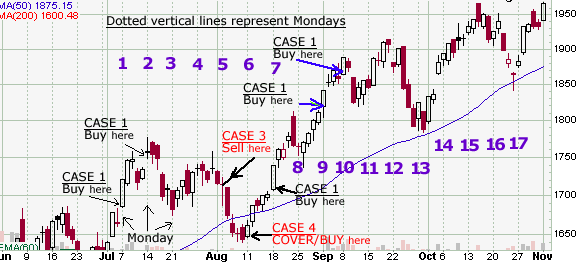
Look at Number 1 above. On Monday, July 7th, IXIC opened significantly higher than previous Friday's Close level. So we would apply CASE 1 discussed above and would take long positions on that Monday morning. Now as you see IXIC kept going up over the next three days. So trades based on this signal would give good profit here.
Look at Number 2 now for Monday, July 14th. Again Monday's Open was significantly higher than Friday's Close. So as per CASE 1, we would go long. Here, the index did not go higher but stayed around the same level for the next two days. So here we may or may not have good profit!
If you look at Number 3 on July 21st, it told us to go short in the morning as per CASE 3. Then the price did go lower and closed lower for the day. However if we did not book profit on the same day, we could have closed our short position on the very the next day as we had a FULL STOP (BUY) signal pointing to the end of the Reaction the stock was going through! So we would have been able to close our short position without much profit/loss here.
Next
signal would not get us much profit or loss either. Now look at Number
5 on Aug 4th. The stock opened at almost the same rate as Friday's
Close. However after going up few points, it started going down and when
it went below Friday's Close, we would go short as per CASE 3. Next four
days would have brought us good profit here. Similarly Number 6 and 7
would have told us to take long positions on those Monday mornings; and
if you looked at the subsequent days, we would find good profit there.
For Number 8, we would have been in and out of the trade quickly without
any significant profit or loss. However Number 9 would have yielded us
a handsome profit! Similarly Number 14, 15 and 17 were very profitable
MONDAY MORNING signals.
I hope you are able to understand this signal clearly. I would like to emphasize few things here.
If you
liked content on this page, please do share with your friends on Facebook:
(Note: If you get confused by some term(s) used on this page, you can read about it clicking on this link. Don't give up. Try to understand this signal because this can make you lots of money.)
Disclaimer: This trading system/signal, like any other system, may fail at times. Exercise caution when trading and decide suitability of any trade by taking into consideration market conditions, your financial situation, investment objectives and circumstances. Always keep a stop-loss when you are trading.
All
content on this website and the ProfitFromPrices eBook are copyrighted
material
COPYRIGHT © 2004 by Jayesh Patel
For privacy policy, click here. Google